
Charleston County Busted Mugshots and Booking
A busted mugshot in Charleston County usually begins at Sheriff Al Cannon Detention Center. That is the county's adult booking facility. It does not matter who made the arrest. Charleston Police may have picked the person up. So may North Charleston, Mount Pleasant, or state officers. Either way, the jail booking lands in the county system. A summons, citation, or field release works differently. It can leave no county booking record at all.
The Charleston County Sheriff's Office runs the detention center and its official Inmate Search. A booking photo shows who came in that day. Outcomes live in the court file. So the search screen and the case record do very different jobs for anyone checking a name.
Important: Check the current case status in the official court record before drawing conclusions from any Charleston County booking entry or photo.
Sheriff Al Cannon Detention Center Booking Context
Sheriff Al Cannon Detention Center, or SACDC, sits at 3841 Leeds Avenue in North Charleston. It is the county's adult booking location. CCSO describes a four-building operation with a capacity of 1,693. That figure followed the 2020 removal of modular units and the work camp. The facility dates to 1966 and grew over the years. None of that history tells you how crowded it is now, where someone is held, or when they might get out.
County material also notes a juvenile detention facility nearby. The adult inmate search is not a juvenile-record source. Keep those searches apart. The clean rule: a confirmed adult SACDC booking is county business, while the arresting agency and the court case sit with other offices.
Charleston County Booking Record Fields
A public search and a written records request rarely match field for field. That gap is why one name is never enough. The booking date and the arrest date sit in separate fields. A current-custody result is not a historic booking. The arresting agency can differ from the holding facility too. Treat each result as one documented slice of a case, never a full history.
| Field or feature | What it can show |
|---|---|
| Name or inmate identifier | A name search or inmate number helps locate the adult jail record. Similar names still require care. |
| Booking and arrest dates | Separate date ranges identify intake and arrest events that may not have happened on the same day. |
| Current or past booking | The default view concerns current custody; the past-bookings option expands the search for a prior adult booking. |
| Booking photo | CCSO identifies the official portal as its booking-photo path when the pertinent booking is available. |
| Charge, agency, bond, and court information | These are booking-stage details. Bond is a custody condition, and the court docket supplies the disposition. |
| Custody or release status | A current result reflects the portal's custody view; a past result describes an earlier booking rather than a court outcome. |
People tend to blur booking, arraignment, bond, disposition, and expungement into one vague idea of getting arrested. Each is a distinct event with its own paperwork, date, and custodian.
- Booking
- Intake into a detention system, including identification and administrative record creation.
- Arraignment
- A court proceeding where a charge is formally addressed under the applicable process.
- Bond
- A release condition or financial arrangement, not a decision about guilt.
- Disposition
- The later court result, such as a dismissal, plea, acquittal, or another resolution.
- Expungement
- A court-controlled process that can affect public access to eligible records.
Request Charleston County Busted Mugshots and Records
When the online search comes up empty, try the written route. The Sheriff's Office handles it well. Its FOIA request form wants enough detail to pin down a record. For a booking, give the person's name plus an arrest or booking date. Add the SACDC location, the exact record you want, and your preferred format. Ask for the booking photo separately if that is the piece you need. One caution: city police incident reports belong with the city department, not CCSO.
- Use the official inmate search first, including a date range and the past-bookings choice when release is possible.
- Describe the person, relevant date, adult facility, and specific booking record or image on the CCSO form.
- Send the request to the Public Information Office, 3691 Leeds Avenue, North Charleston, SC 29405, or PIO@charlestoncounty.org.
- Review any estimate, deposit request, exemption, or redaction notice before expecting production.
- Use the court file for the disposition rather than asking a booking custodian to decide the case outcome.
The published fee schedule covers copies, research time, media, email searches, retrieval of older files, and postage. It permits a deposit once an estimate crosses the stated threshold. None of that guarantees a particular image will be released. Records under two years old get an initial response within ten business days, weekends and public holidays excluded. Older records carry a twenty-day window. Availability and production stay separate steps under South Carolina FOIA.
Can an older booking still be requested? Yes. CCSO adds a $5 off-site retrieval charge per case for files three or more years old. Located records can still face exemption or redaction limits.
Charleston County Booking Record Costs
The CCSO fee schedule is a solid planning tool when an online entry runs thin. Copies or provided pages run $0.20 each. Research is billed at the lowest-paid qualified employee's rate, with a $25 hourly minimum in one-tenth-hour increments. Photos, videos, audio, and data disks cost $20. An email search runs $70. Flat-rate postage is $8.50 when requested. A 25 percent deposit applies once an estimate hits $75.
These figures attach to records requests, not the inmate-search form, which stays free. A dispatcher recording falls under a separate category and goes to Charleston County Consolidated 9-1-1, not CCSO. Ask the right custodian for existing material only. State law allows reasonable charges for research, retrieval, redaction, and reproduction. It equally allows a lawful withholding.
Charleston County Busted Mugshots Under South Carolina Law
South Carolina opens its records through Title 30, Chapter 4 of the state code. The CCSO request form leans on the booking-identity language in Section 30-4-30(D). Access still has limits. An agency cannot be forced to build a record it never kept, and lawful redactions or exemptions may trim what you get back. Juvenile files and sealed material follow separate rules that do not apply to ordinary adult booking information.
Two other statutes matter here. Section 17-1-60 targets outfits that publish booking material and charge fees for removal. It builds a documented no-cost path for written requests backed by the final court result. It also treats revision after certain pleas differently from outright removal. Section 17-1-40 covers eligible expungements, including destruction plus limited sealed retention. Its three-years-and-120-days window is a sealed-retention rule after expungement, not a promise about how long a webpage stays up.
Start any correction with the court disposition or expungement order. Bring it to the custodian that holds the official record. The South Carolina Judicial Branch process handles General Sessions, juvenile, and magistrate or municipal cases along different tracks. If an unofficial publisher is in the mix, use its no-fee correction route and keep proof you asked. Once the source page is gone or changed, the Google Remove Outdated Content tool clears the stale search hit, though it cannot touch a page still live at its origin. Read the official South Carolina statute governing the record and removal rules.
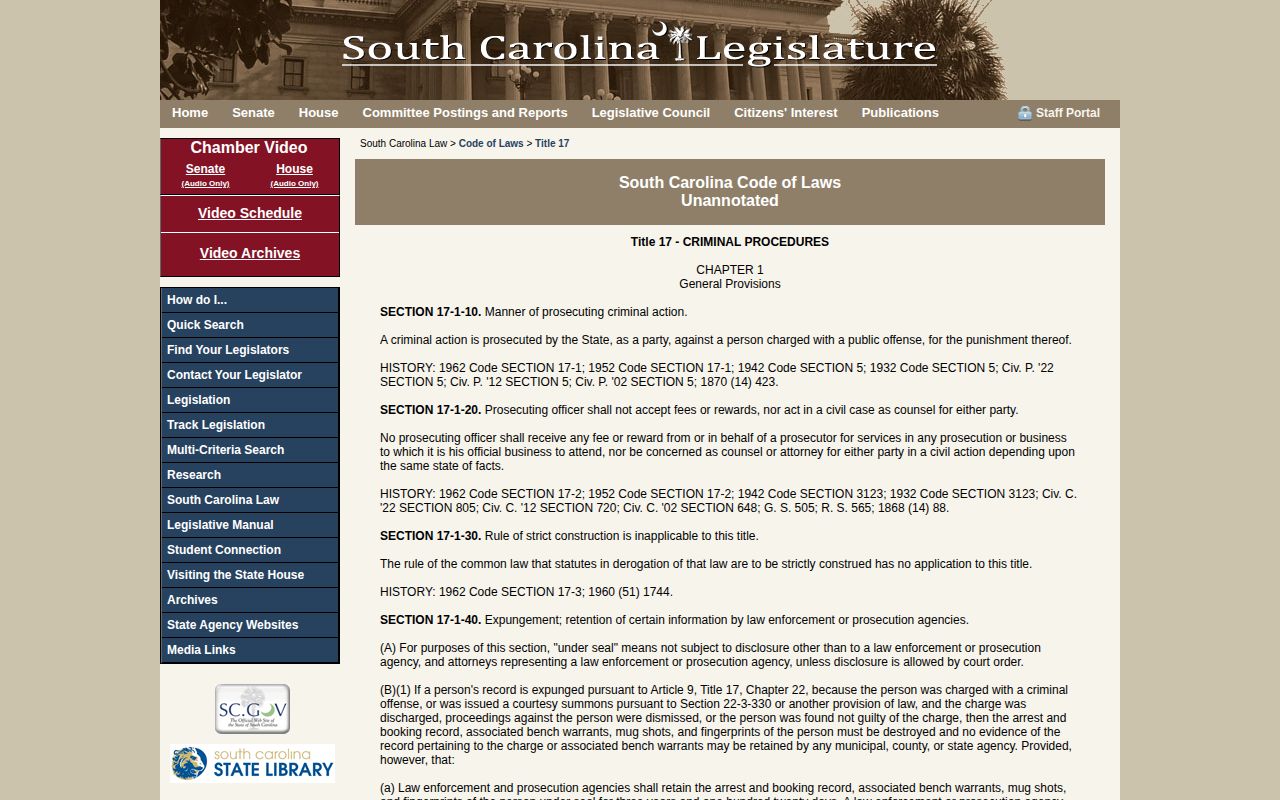
The statute text spells out three things people often blur together: fixing an official record, clearing an expunged case, and killing a stale search result. Each one works differently.
Find Charleston County Busted Mugshots Officially
Where you look depends on one thing: custody status. Someone freshly booked into the Sheriff Al Cannon Detention Center should appear in the CCSO inmate search. Released since then? The same site can pull past bookings with a separate query. A person serving a state sentence after conviction shows up in the South Carolina corrections system instead. Court dockets answer a different question about where a case stands after the booking.
- Open the CCSO Inmate Search and complete its reCAPTCHA.
- Search by name, inmate number, booking date range, or arrest date range, using the fact that the two dates can differ.
- Use the current-inmate view for present adult county custody. If a release is possible, repeat the search with “Show Past Bookings.”
- Move to the SCDC search only for a person currently sentenced to and incarcerated in state prison, then use the county court path for the case result.
- When the online entry is missing or too limited, submit the focused CCSO request rather than treating a secondary listing as confirmation.
Warrants are a separate track from the roster. The Most Wanted Fugitives page explains when a warrant check makes sense and how CCSO confirms one. Keep the two searches distinct. A name on the jail roster tells you about custody, while a warrant search tells you whether deputies are actively seeking someone, and neither result substitutes for the other.
Why a Charleston County Booking Can Be Delayed
One timing quirk matters here. In February 2026, CCSO announced a delay in posting adult inmate-search results, a step taken to shield families from impersonation scams. So a person can be booked at the jail and still be invisible to the public system for a while. No fixed hour count exists, and nobody should promise a same-day listing. A blank result never proves the arrest did not happen.
For anything urgent, go straight to the official form. Narrow the date window and use verified CCSO contact details. Treat the posting delay as a reason to confirm with the agency itself. Hang up on any caller demanding money or offering a callback number. The delay is built in on purpose, and working around it with unofficial listings only invites bad information.
Charleston County Jail Roster Date Search
Charleston County does not publish a static jail roster. Instead, CCSO runs one dynamic Inmate Search for adults. The default view, "Search for Current Inmates," takes a last and first name, an inmate number, booking-date and arrest-date ranges, and an optional sounds-like match. One local feature deserves attention: a past-bookings checkbox widens the lookup beyond current custody to earlier adult bookings. You still have to complete the portal's reCAPTCHA for results to display, so plan on that step.
| Search field | Best use |
|---|---|
| Last and first name | Start with the clearest known spelling, then evaluate similar-name results carefully. |
| Inmate number | Use it when known for a more focused adult county search. |
| Booking date range | Use it when the question is about the jail intake event. |
| Arrest date range | Use it when the arrest date is known, remembering it may differ from the booking date. |
| Sounds-like match | Use it for a name that may have alternate spelling. |
| Show Past Bookings | Select it when a release is possible and a historic adult booking is the target. |
CCSO's 2025 release labels this the photo path. It also points to past bookings for anyone already out of custody. What you see is a live system view. The agency never posts a fixed refresh interval, nor a standard retention window for the web. Treat a result as a moment-in-time roster entry. It is not a permanent archive.
Charleston County Busted Recent Booking Searches
No separate 24-hour, 48-hour, 72-hour, weekly, or rolling arrest-log page exists for Charleston County in these sources. The closest official tool is the date query built into the inmate search. Want a same-day check? Drop the calendar date into the booking or arrest date fields and run the search against current adult custody. Remember that this is date-bounded rather than a real-time feed, and posting delays can slow what appears. For a stretch of several days, set a focused date span and switch on "Show Past Bookings" if the person may already be released.
CCSO publishes no maximum public date window, no downloadable weekly log, and no stated archive period. Its news releases are hand-picked communications, not a full booking feed. CPD and NCPD offer no verified public booking pages for adults. Mount Pleasant's map tracks incidents rather than a busted-in list.
What if a date search returns nothing? Widen the arrest-date or booking-date range. Retry with past bookings where that fits. If the question still hangs, go through the CCSO records route for a narrow official copy.
Charleston County Custody Alerts and State Records
No CCSO app exists for jail lookups or booking photos on a phone. The practical mobile tool is SC VINE, a statewide service that tracks custody status and sends alerts across county detention centers, SCDC prisons, and community supervision. It offers an automated phone line too. Call 1-866-727-2846 for status updates. Just know its limits: alerts only, no photo archive.
Looking for someone in state prison instead? Use the SCDC Incarcerated Inmate Search. That database covers current prisoners as of the prior midnight and may show a photo plus public details. It won't help with someone held at SACDC awaiting trial, a person already released, a county-level sentence, juvenile custody, or supervision. Search by SCDC number or state ID number when you have one. View the South Carolina Department of Corrections inmate-search interface.
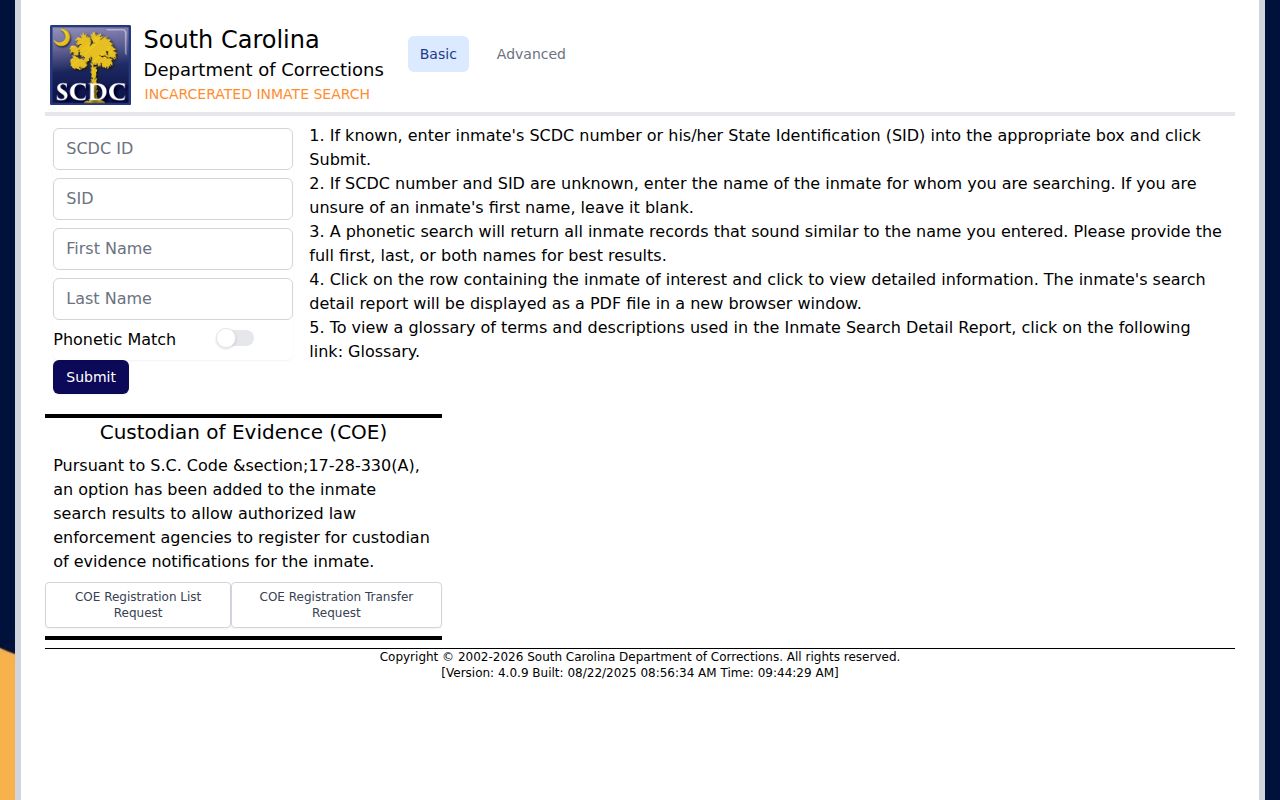
Confirm the custody transition first, then turn to the state-prison channel. It fills a gap rather than replacing the county booking record.
Charleston County Bond Hearing After Booking
Bond hearings happen at Centralized Bond Hearing, 3870 Leeds Avenue, Suite 106, North Charleston, SC 29405. Friends and family can attend. CCSO publishes this as processing information, not a bond schedule, and it can't promise anyone walks out at a given hour. A roster entry may shift after a bond decision. Past bookings and court files live in separate systems.
Bond sets a custody condition, nothing more. A booking record might display a bond figure, yet the court alone shapes what happens to the charge next. Anyone tracking a pending case should go through the court and agency channels tied to that case.
Charleston County Booking Charges and Court Dispositions
The Charleston County Public Index anchors the court side of a search. Circuit Court and General Sessions cases land there. The county's court hub adds magistrate records, and City of Charleston municipal matters follow their own path. Bring a case number or exact person details when you can. Booking charges shift, and dockets can hold delayed, sealed, or confidential material.
Three court levels matter in Charleston County. Circuit Court and General Sessions carry the criminal cases. Magistrate courts keep their own records and forms. Municipal matters stay separate, and a clerk can point you to the right record path. Need a copy of a CCSO arrest disposition? The Sheriff's Warrants page sends requesters to the Records Office at 3505 Pinehaven Drive in North Charleston.
Case status matters: A Charleston County booking charge is just the starting point, so check the official docket for the current status, dismissal, or later outcome.
Charleston County Busted Booking Court Routes
Which court applies depends on the charge and where the case was filed. County resources link to Circuit Court case search and magistrate records search, while municipal matters run on a separate track. The City of Charleston, for instance, runs its own municipal court and publishes expungement details. Use the case number. Two people can share a name.
This is why a booking record can't answer every question. The jail describes intake and custody. The arresting city department may hold the original incident report. The court holds the proceeding and its outcome. When the venue is unclear, ask the right clerk rather than treating a booking-photo page as a full legal history.
Charleston County Busted Bookings After Release
Custody changes move a record around. A current SACDC roster hit, a past county booking, a state-prison result, and a federal locator each cover different time periods. Release from the county roster doesn't cancel out a historic-booking query. A transfer to SCDC says nothing about the court case. Keeping these records straight prevents mix-ups.
| Person's status | Best official route | What that route does not decide |
|---|---|---|
| Currently held in adult county custody | CCSO current-inmate search. | The later court disposition or a statewide custody history. |
| Released after a county booking | CCSO search with “Show Past Bookings,” then PIO/FOIA when necessary. | Whether the case ended in a conviction or another result. |
| Currently sentenced and incarcerated in state prison | SCDC Incarcerated Inmate Search. | The original Charleston County booking record or photo. |
| Federal custody question | Federal Bureau of Prisons locator where its own scope fits. | Whether a person was newly booked into SACDC. |
Federal records sit outside the county system. No public Charleston County ICE booking feed exists, so agency and court records remain the confirmation path.
Where Charleston County Busted Mugshots Appear
Official sources come first because they define what a record means and which custody stage it covers. The CCSO adult search is the county's booking-photo route. SCDC sticks to current state prisoners. SC VINE handles status notifications. The Public Index covers court follow-up. Local news outlets report selected cases, but their stories aren't jail feeds. Each channel has its role.
| Channel | Photo or record role | How to treat it |
|---|---|---|
| CCSO Inmate Search | Adult current custody and past bookings, with the documented photo path. | Official county source. Check dates, past bookings, and the posting-delay limit. |
| CCSO PIO/FOIA | Narrow official booking record or photo request. | Official fallback when a public result is unavailable or incomplete. |
| SCDC Inmate Search | Photo and record for current state-prison custody. | Official, but not a county booking system. |
| SC VINE and court records | Status alerts and the later case record. | Officially sourced for different questions, not a photo gallery. |
| News outlets | Editorial crime or court coverage, sometimes with agency-supplied images. | Use the named agency or court record to verify a story. |
Plenty of unofficial sites post Charleston County busted mugshots these days. You can browse BustedNewspaper, check RecentlyBooked, or scroll through Arrests.org and Mugshots.zone. Just know what you are looking at. Listings on these pages can sit untouched for long stretches, carry gaps, or attach the wrong name to a face, and none of them will tell you where a person stands right now with the sheriff or the courts. When a story catches your eye and you want the record behind it, the Crime News page maps out the local outlets and shows how to trace a report back to the agency that actually holds the file.
Charleston County Historic Booking Record Path
Want an older booking from Charleston County? Start with the "Show Past Bookings" link on the CCSO site. Nobody publishes a firm timetable for how long a photo or old entry stays visible. If the entry you need has dropped off the portal, a written PIO or FOIA request works best. Give them a name or inmate number, a rough date, and the facility. CCSO processing documents say inactive files get moved to the Charleston County Records Center. That alone doesn't confirm any specific file survived there or can be released to the public.
For questions about retention schedules, the South Carolina Department of Archives and History schedules page is the state's official source for county and local-government timelines. It lists no public online archive of Charleston County historic booking photos. Archival hunting, court outcomes, and expungement rules are three separate tracks. A record eligible for expungement can be sealed or destroyed under its own rules, so keep those questions apart.
Charleston County Busted Mugshots by City
City police paperwork and county booking records live with different custodians. Every city page here opens with that city police department's own records route. Then it points any adult county-booking question toward the CCSO portal. The order is deliberate. A city arrest doesn't always lead to adult county custody. North Charleston spills across county lines, which complicates things further.
- Charleston Busted Mugshots: CPD records and FOIA context, then the county adult booking path.
- Mount Pleasant Busted Mugshots: the MPPD incident-map context and the SACDC record distinction.
- North Charleston Busted Mugshots: NCPD public-information context and the need to confirm the booking county.
Get Charleston County Booking Records In Person
Sheriff Al Cannon Detention Center
3691 Leeds AvenueNorth Charleston, SC 29405